

Biotaderm Deep Dry Sensitive Hand and Foot Cream
Rich moisturiser for hands, elbows and feet, made for dry, sensitive skin
The richest of the three textures, made for skin that is thick, dry and hard-worked. Over nineteen percent of the formula is plant oil, roughly twice what the face texture carries. Every ingredient and every percentage is published below.
What it is, and who it’s for
Deep is the richest thing we make. Over nineteen percent plant oils against Flow's nine, which is what hands, heels, elbows and knees need, and more than most faces want.
The blend is the one we use for dry, sensitive skin throughout the range: baobab and evening primrose at the front, dragon fruit, tamanu for conditioning, and sea buckthorn at a full percent. Around those sits the same supporting cast as every Biotaderm formula, built at skin pH and held there by sodium citrate.
It is for the parts of you that take a beating and get ignored.
Work a small amount into the skin as often as you need it. Hands after washing, feet before bed. It is rich, so start with less than you would use of a body cream and add more if it wants it.
How it feels
A rich cream that spreads easily over dry skin without warming it first. It stays where you put it.
Absorbs with a little rubbing. Any oily feel fades quickly, leaving a satin finish.
The plant oils, with the earthy, slightly citrus note of the vetiver. You notice it for a few minutes, then it fades.
Key ingredients
Five oils do the work here, chosen for dry, sensitive skin rather than for how they read on a label. Each has its own entry in the ingredient library, with the evidence and its limits set out in full.
Baobab Seed Oil Adansonia Digitata
A balanced oil that softens and helps skin hold onto moisture, without the heaviness of the more occlusive butters. Organic and cold-pressed.
Dragon Fruit Seed Oil Hylocereus Undatus
A light seed oil, rich in linoleic acid, with antioxidant activity from its tocopherol content. It sits well on skin that finds heavier oils uncomfortable. Cold-pressed.
Evening Primrose Oil Oenothera Biennis
One of the few plant oils rich in gamma-linolenic acid. Studies suggest GLA-rich oils support barrier function in skin that is dry and easily provoked, and it has a long record of comfortable use on reactive skin.
Tamanu Seed Oil Calophyllum Inophyllum
A thick, conditioning oil with a long history of traditional use on damaged and irritated skin. The published evidence is thinner than the folklore, so we use it for what it demonstrably does, which is soften and soothe.
Sea Buckthorn Fruit Oil Hippophae Rhamnoides
Present in small quantity, and deliberately so. It is dense in carotenoids, which is where its antioxidant interest lies, and also where its strong orange colour comes from. Past a certain level it would tint the cream and anything it touched, so the amount here is set by that limit rather than by ambition.
Bladderwrack Fucus Vesiculosus, our signature Atlantic seaweed
The same species you will find on the rocks below Welcombe at low tide. Ours is a cold, solvent-free infusion in sunflower oil, made in the UK. The infusion carries fucoxanthin, the seaweed's golden pigment, which gives it a modest antioxidant character, helped by the vitamin E in the sunflower oil that carries it. That, and the brand's ties to this coast, is why it is in every formula we make.
Every Biotaderm moisturiser also contains squalane, a postbiotic barley ferment upcycled from gin distilling, the plant prebiotic inulin, allantoin, vitamin E and chlorella.
Every ingredient is named on the label, with nothing hidden under "fragrance" or "parfum", so you can check the formula against anything your skin dislikes. If your skin reacts easily, patch test on the inside of your forearm before first use.
This formula contains one essential oil, vetiver root oil, at a tenth of a percent. Vetiver root oil is rich in antioxidant compounds, chiefly the vetivones, and the research that identified them tested the same steam-distilled root oil we use. It also gives the cream its quiet, earthy scent and softens the sharper notes of the cold-pressed oils.
It appears on the label under its own name, never inside a "parfum" catch-all. That is why we describe the range as having no synthetic fragrance rather than as fragrance-free.
What it comes in
What it comes in, and how long it lasts.
| Volume | 150ml ℮ |
|---|---|
| How long it lasts | Up to a month used a few times a day on the areas that need it most. |
| Bottle | Aluminium, with a bamboo and plastic pump. The bottle can be recycled. |
| Once opened | Six months. |
| Batch | Batch number and best-before are printed on the label. |
Full formulation
Every ingredient in descending order by weight, including those below one percent, where the rules allow any order.
| Ingredient (INCI) | % | Skin function |
|---|---|---|
| Aqua | 58.42 | Base of the cream, carrying everything that dissolves in water |
| Glycerin | 6.00 | Humectant that draws and holds moisture |
| Adansonia Digitata (Baobab) Seed Oil*^ | 5.04 | Softens skin and helps retain moisture |
| Oenothera Biennis (Evening Primrose) Oil*^ | 5.04 | GLA-rich oil that softens skin and may support the barrier |
| Hylocereus Undatus (Dragon Fruit) Seed Oil^ | 4.58 | Linoleic-rich seed oil with antioxidant activity |
| Cetearyl Olivate | 3.30 | Olive-derived emulsifier; forms layers like the skin's own lipids |
| Calophyllum Inophyllum (Tamanu) Seed Oil*^ | 2.75 | Rich conditioning oil |
| Sodium Citrate | 2.25 | Holds the formula at skin pH |
| Sorbitan Olivate | 2.20 | Olive-derived emulsifier, paired with cetearyl olivate |
| Cetearyl Alcohol | 2.00 | Fatty alcohol; emollient and thickener |
| Gluconolactone | 1.13 | Part of the preservative system |
| Hippophae Rhamnoides (Seabuckthorn) Fruit Oil*^ | 1.00 | Carotenoid-rich oil with antioxidant activity |
| Squalane | 1.00 | Lightweight emollient that helps slow water loss |
| Saccharomyces/Barley Seed Ferment Filtrate# | 1.00 | Barley ferment that helps skin hold moisture |
| Helianthus Annuus (Sunflower) Seed Oil | 0.85 | Linoleic-rich oil that supports the skin barrier |
| Tocopherol (Vitamin E) | 0.51 | Antioxidant that protects the oils in the formula |
| Caesalpinia Spinosa (Tara) Gum | 0.50 | Thickens the cream and steadies the emulsion |
| Glyceryl Caprylate | 0.50 | Plant-derived emollient that supports the preservative |
| Allantoin | 0.50 | Soothes and softens skin |
| Inulin | 0.50 | Humectant and plant prebiotic; feeds beneficial skin bacteria in lab studies |
| Sodium Benzoate | 0.38 | Preservative that stops microbes growing in the bottle |
| Propanediol | 0.30 | Carries the chlorella extract; also a humectant |
| Fucus Vesiculosus (Bladderwrack) Extract | 0.14 | Atlantic seaweed with a modest antioxidant note |
| Vetiveria Zizanioides (Vetiver) Root Oil* | 0.10 | The only essential oil in the range; a faint earthy scent |
| Chlorella Vulgaris (Microalga) Extract | 0.008 | Microalgal extract; its maker's laboratory work suggests it favours helpful skin bacteria |
| Lactic Acid | 0.002 | Holds the chlorella active at its acidity; a trace |
* Organic ^ Cold-pressed # Upcycled
Common questions
Flow, Core or Deep? How do I choose?
By where you are putting it rather than by how dry your skin feels. Flow is the lightest of the three and is built for the face, at around nine percent plant oils. Core carries more and suits the body. Deep carries most and is for hands, elbows and feet, the places that take a battering.
The skin type is the second choice, and that one is about how your skin behaves. The skin type finder sorts it in two questions.
Is Deep only for hands and feet?
No. It is built for skin that is thick, dry and hard-worked, which usually means hands, heels, elbows and knees, but it goes anywhere that needs it. Shins in winter, for example.
At around nineteen percent plant oils it is the richest thing we make, so on the face it will feel like a lot for most people.
My skin reacts to essential oils. Should I try this one?
There is one essential oil in here, vetiver root oil, at a tenth of a percent. It is named on the label under its own name rather than hidden inside a parfum listing, so you can see exactly what you are dealing with.
Whether that suits you is something only your skin can answer. If you have reacted to aromatics before, patch test on the inside of your forearm and leave it a couple of days before putting it near your face.
 Made to be gentle on skin
 Microbiome-friendly
 Naturally derived
 Every formulation published
 Vegan and cruelty-free
Handmade in small batches in Welcombe, north Devon.
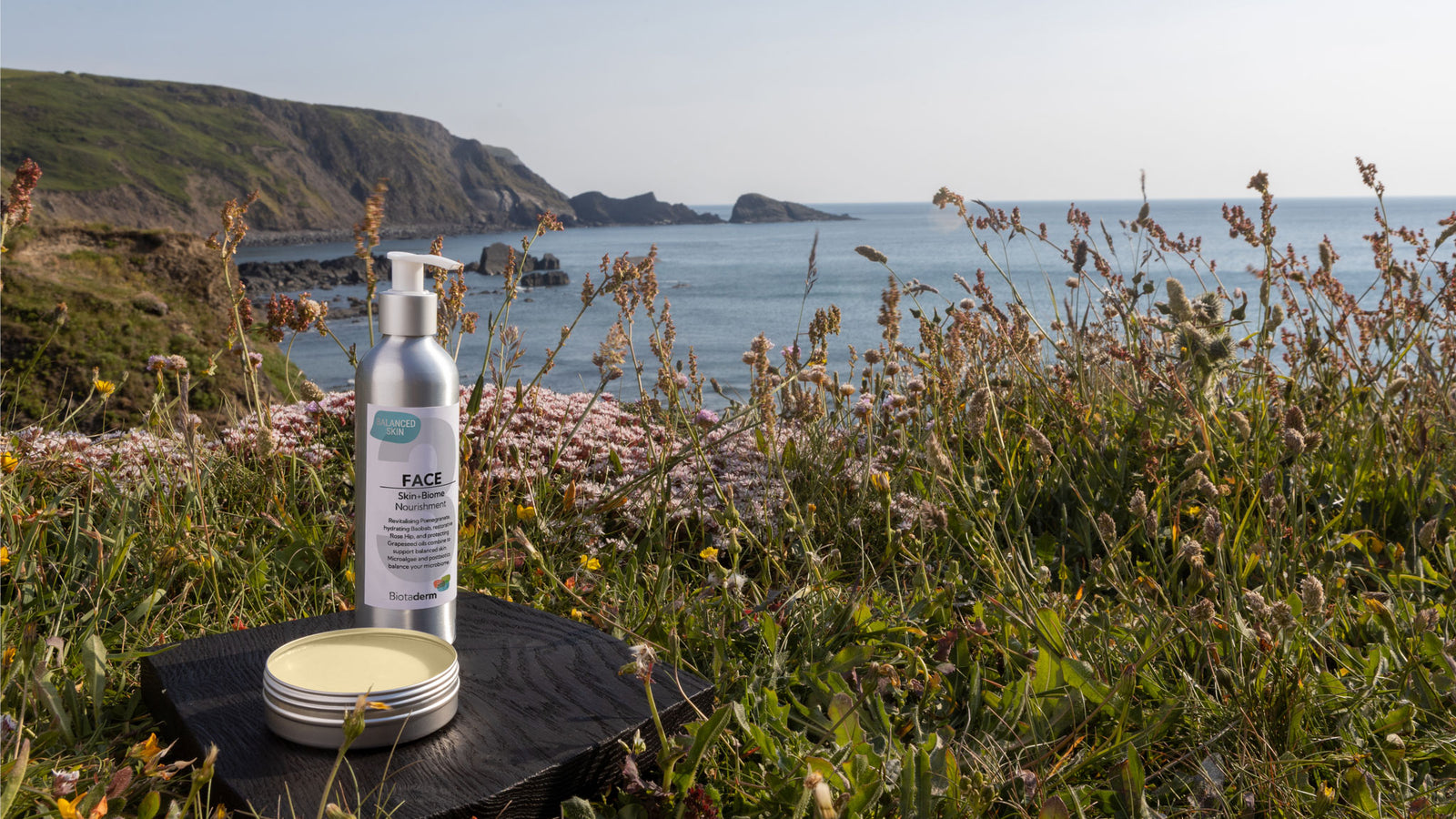
Low tide below Welcombe, where the bladderwrack grows
