

Flow Dry Light Moisturiser
Nourishing face moisturiser for dry skin
The lightest of the three textures, made for facial skin that runs dry. Around nine percent of the formula is plant oil, enough to soften and hold moisture without sitting heavily. Every ingredient and every percentage is published below.
Formulated to limit the potential to react with your skin. No ingredients hidden under catch-all terms like fragrance or parfum. Always patch test first if your skin can be reactive.
What it is, and who it’s for
Flow is our face texture. It carries around nine percent plant oils, which is generous for something this light, and the blend here leans on the oils that suit dry skin: baobab and evening primrose in equal measure, jojoba for a finish that does not feel occlusive, tamanu for conditioning, and a little sea buckthorn for its carotenoids.
Around those sits the same supporting cast that runs through every Biotaderm formula. A postbiotic ferment, a prebiotic, plant squalane, allantoin, vitamin E. The formula is built at skin pH and held there by sodium citrate, which is the plainest thing we do for the skin microbiome and the best evidenced.
It suits skin that feels tight after washing and stays that way through the day.
Warm a small amount between your fingertips and press it into clean skin, once or twice a day, before any cosmetics or sunscreen. Only a little is needed. Avoid the immediate eye area.
How it feels
A light cream that spreads smoothly and easily. A pea-sized amount will cover the whole face, and it spreads thin without dragging.
Rapidly absorbed with little working. The skin is left with a satin finish and ready to take on any additional products such as make-up or sunscreen.
A balance between the natural cold-pressed organic oils and the earthy, slightly citrus tones of the vetiver. Noticeable for a few minutes and then gone.
Key ingredients
Five oils do the work here, chosen for dry skin rather than for how they read on a label. Each has its own entry in the ingredient library, with the evidence and its limits set out in full.
Baobab Seed Oil Adansonia Digitata
A balanced oil that softens and helps skin hold onto moisture, without the heaviness of the more occlusive butters. Organic and cold-pressed.
Evening Primrose Oil Oenothera Biennis
One of the few plant oils rich in gamma-linolenic acid. Studies suggest GLA-rich oils support barrier function in skin that is dry and easily provoked, and it has a long record of comfortable use.
Jojoba Seed Oil Simmondsia Chinensis
Technically a liquid wax rather than an oil, and close enough in structure to the skin's own sebum that it sits well on most people. It conditions without feeling like a layer.
Tamanu Seed Oil Calophyllum Inophyllum
A thick, conditioning oil with a long history of traditional use on damaged and irritated skin. The published evidence is thinner than the folklore, so we use it for what it demonstrably does, which is soften and soothe.
Sea Buckthorn Fruit Oil Hippophae Rhamnoides
Present in small quantity, and deliberately so. It is dense in carotenoids, which is where its antioxidant interest lies, and also where its strong orange colour comes from. Past a certain level it would tint the cream and anything it touched, so the amount here is set by that limit rather than by ambition.
Bladderwrack Fucus Vesiculosus, our signature Atlantic seaweed
The same species you will find on the rocks below Welcombe at low tide. Ours is a cold, solvent-free infusion in sunflower oil, made in the UK, and we would rather be plain about what that form carries. The fucoidans and phlorotannins the seaweed is famous for are water-soluble and largely stay behind. What crosses into the oil is fucoxanthin, the golden pigment, which gives a modest antioxidant note. That, and a real kinship with the coast this brand comes from, is why it is here. It is in every formula we make.
Beyond these, every Biotaderm moisturiser shares the same quiet supporting cast: squalane, a postbiotic ferment upcycled from gin distilling, prebiotic inulin, allantoin, vitamin E and chlorella.
There is one essential oil in this formula. Vetiver root oil, at a tenth of a percent, for its antioxidant properties and the quiet earthy note it gives the blend. It is named on the label under its own name, never folded into a "parfum" catch-all.
That means the honest description of this product is "no synthetic fragrance" rather than "fragrance-free". One is true. The other would not be. A concentrated aromatic can still be a lot for a fragile barrier, which is why the level is kept low and why a patch test is worth the trouble if your skin runs reactive.
What it comes in
What it comes in, and how long it lasts.
| Volume | 150ml ℮ |
|---|---|
| How long it lasts | Four to six weeks when used once a day on the face. |
| Bottle | Aluminium, with a bamboo and plastic pump. The bottle is refillable, and can be recycled. |
| Once opened | Six months. |
| Batch | Batch number and best-before are printed on the label. |
Full formulation
Every ingredient in strict descending order by mass, carried below the one percent mark where the rules stop requiring it.
| Ingredient (INCI) | % | Skin function |
|---|---|---|
| Aqua | 71.22 | Hydrating base carrying water-soluble actives |
| Glycerin | 6.00 | Humectant that draws and holds moisture |
| Adansonia Digitata (Baobab) Seed Oil*^ | 2.30 | Softens skin and helps retain moisture |
| Oenothera Biennis (Evening Primrose) Oil*^ | 2.30 | Replenishes barrier lipids, calms sensitive skin |
| Sodium Citrate | 2.25 | Holds the formula at skin pH |
| Cetearyl Olivate | 2.25 | Olive-derived emulsifier; skin-friendly, lipid-like texture |
| Simmondsia Chinensis (Jojoba) Seed Oil*^ | 2.09 | Sebum-like wax that conditions and balances |
| Sorbitan Olivate | 1.50 | Olive emulsifier supporting skin-like structure |
| Calophyllum Inophyllum (Tamanu) Seed Oil*^ | 1.26 | Conditioning oil that helps soften and soothe |
| Gluconolactone | 1.13 | Part of the preservative system; keeps the formula safe |
| Squalane | 1.00 | Lightweight emollient that reduces moisture loss |
| Cetearyl Alcohol | 1.00 | Fatty alcohol; emollient and thickener |
| Saccharomyces/Barley Seed Ferment Filtrate# | 1.00 | Postbiotic that supports the barrier and calms skin |
| Helianthus Annuus (Sunflower) Seed Oil | 0.85 | Linoleic-rich oil that supports the skin barrier |
| Tocopherol (Vitamin E) | 0.51 | Antioxidant protecting skin lipids and oils |
| Glyceryl Caprylate | 0.50 | Coconut-derived emollient that aids preservation |
| Allantoin | 0.50 | Soothes skin and supports natural repair |
| Inulin | 0.50 | Prebiotic humectant that feeds skin microbes |
| Hippophae Rhamnoides (Seabuckthorn) Fruit Oil*^ | 0.46 | Antioxidant barrier support for stressed skin |
| Caesalpinia Spinosa (Tara) Gum | 0.45 | Forms a film that helps hold in moisture |
| Sodium Benzoate | 0.38 | Gentle preservative keeping the product safe |
| Propanediol | 0.30 | Plant humectant that also aids absorption |
| Fucus Vesiculosus (Bladderwrack) Extract | 0.14 | Atlantic seaweed with a modest antioxidant note |
| Vetiveria Zizanioides (Vetiver) Root Oil* | 0.10 | Aromatic root oil with antioxidant properties |
| Chlorella Vulgaris (Microalga) Extract | 0.008 | Antioxidant, soothing microalga |
| Lactic Acid | 0.002 | Adjusts pH; present at trace level |
* Organic ^ Cold-pressed # Upcycled
Common questions
Flow, Core or Deep? How do I choose?
By where you are putting it rather than by how dry your skin feels. Flow is the lightest of the three and is built for the face, at around nine percent plant oils. Core carries more and suits the body. Deep carries most and is for hands, elbows and feet, the places that take a battering.
The skin type is the second choice, and that one is about how your skin behaves. This is the Dry Sensitive formulation, for skin that feels tight after washing and tends to object to new products.
Can I use Flow on my body as well as my face?
You can, though you will get through it quickly. Flow is formulated light enough for facial skin, so on arms and legs you end up using rather a lot of a 150ml bottle to cover ground that Core would handle with less. If you want one product for both, Core is the more sensible buy.
My skin reacts to essential oils. Is this one safe for me?
There is one essential oil in here, vetiver root oil, at a tenth of a percent. It is named on the label under its own name rather than hidden inside a parfum listing, so you can see exactly what you are dealing with.
Whether that suits you is something only your skin can answer. If you have reacted to aromatics before, patch test on the inside of your forearm and leave it a couple of days before putting it near your face.
 Gentle, skin friendly
 Microbiome friendly
 Natural
 Formulation Clear
 Cruelty free
Handmade in small batches in Welcombe, north Devon.
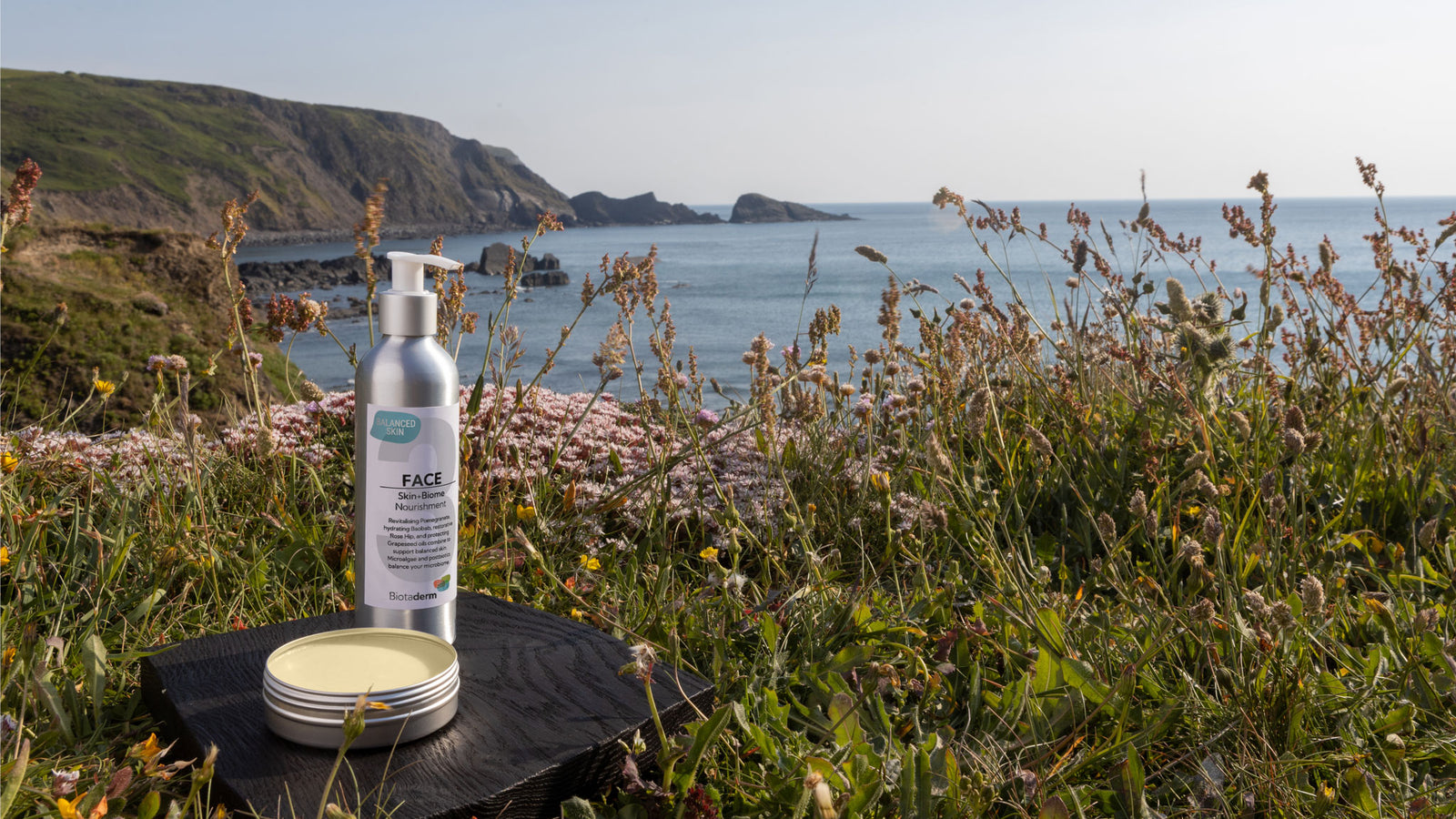
Low tide below Welcombe, where the bladderwrack grows
